

The number one reason loan officers don't post on social media is time.
They know they should be posting.
They know it works.
They’ve seen other LOs get leads, close deals, and build their brand from social content.
But between processing loans, managing agent relationships, and actually running their business, sitting down to write a week of posts feels impossible.
Here’s the shift:
It doesn’t take a week anymore.
Loan officers in our community are creating 30 days of social media content in about an hour using AI.
Some do it in less.
And this isn’t about blasting out generic AI garbage that nobody reads.
This is about using AI the right way - feeding it your voice, your stories, and your expertise - so the content that comes out sounds like you actually wrote it. If you're not sure what AI tools to start with, start there.
Because the fastest way to kill your brand on social media is posting content that sounds like a robot.
Below is the exact workflow you can plug into your business today.
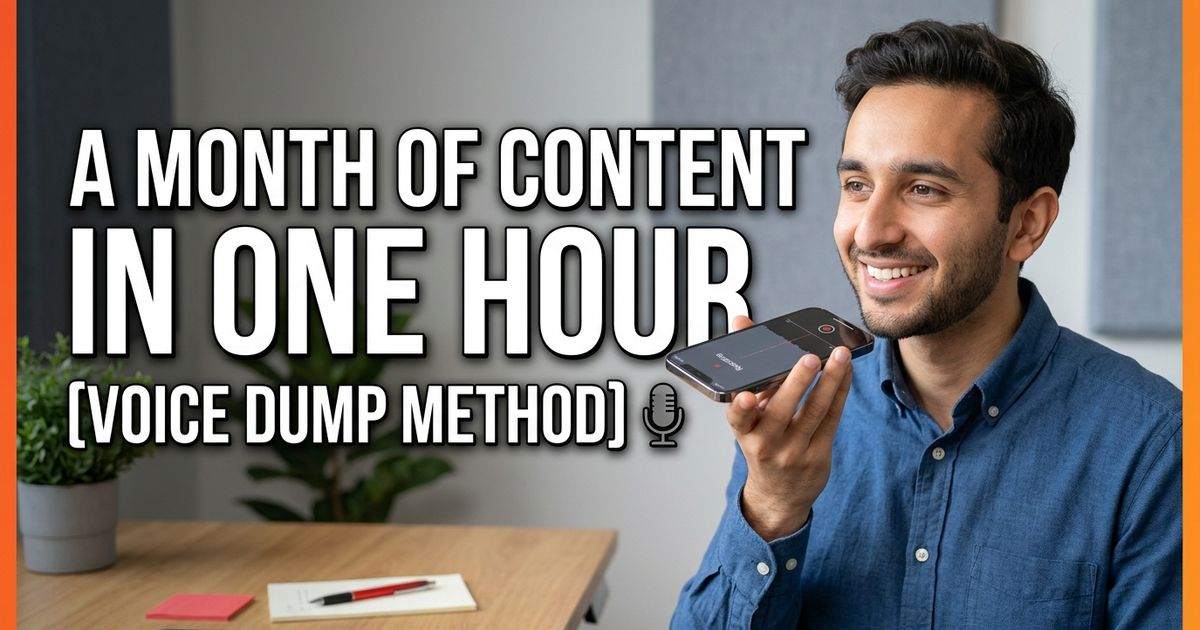
Step 1: Record Yourself Talking for 15 Minutes
Before you open any AI tool, grab your phone and record yourself talking about 3 to 5 topics you know well.
Talk like you’re explaining something to a friend.
No script.
No outline.
Just you being you.
Here are some topics that work great for loan officers:
Spend about 3 minutes on each topic.
Don’t worry about being polished.
The messiness is the point.
That’s your real voice, and it’s what makes your content different from every other LO posting the same recycled tips.
When you’re done, you’ll have 15 minutes of raw material that:
Step 2: Transcribe and Feed It to AI
Next, transcribe your recordings.
Tools like Wispr Flow, Otter, or even your phone’s built-in voice memo transcription work fine.
You don’t need a perfect transcript.
You just need the words.
Then open Claude or ChatGPT and paste in your transcript with clear instructions.
Use a prompt like this:
"Here’s a transcript of me talking about mortgage topics.
Use my exact tone, phrasing, and style as the foundation.
Create 5 social media posts from this material.
Each post should be 150 to 300 words, written in first person, and sound like I’m talking directly to one person.
Use short paragraphs with one sentence per line.
No emojis.
No hashtags in the body.
No rhetorical questions as openers."
That prompt plus your transcript gives AI enough context to produce content that actually sounds like you.
Step 3: Edit for 10 Minutes
This is where most people go wrong.
They either:
Both options kill your efficiency.
The sweet spot is a quick editing pass.
Read each post out loud.
If any sentence sounds like something you’d never actually say, change it.
If there’s a word that feels too corporate or too polished, swap it for the word you’d actually use.
If the post opens with a generic statement instead of something specific, rewrite the first line.
Aim for about 2 minutes per post.
For a batch of 8 to 10 posts, you’re looking at 15 to 20 minutes of editing.
That’s still dramatically faster than writing everything from scratch.
Your goal is what I call the bar test.
If you read the post out loud at a bar to a friend, would it sound natural?
Or would your friend look at you funny because you just said “in today’s competitive mortgage market” out loud?
If it passes the bar test, it’s ready to post.
Step 4: Create the Visuals
Every post needs a visual.
Text-only updates get ignored.
The algorithm rewards visual content, and your audience scrolls right past plain text.
You’ve got a few options depending on how fast you want to move.
For example:
Then all you do is swap the text for each post.
You get consistent branding without starting from scratch every time.
The visual doesn’t need to be a masterpiece.
It just needs to stop someone from scrolling and make the text easy to read.
Step 5: Schedule Everything
Once your posts and visuals are ready, schedule them for the month.
Most loan officers do best posting once a day on their primary platform, 5 days a week.
That’s 20 posts a month—which you can now create in about an hour.
Use whatever scheduling tool you like:
The specific tool doesn’t matter.
What matters is that your content is scheduled and going out whether you remember to post or not.
Consistency is what compounds.
One post that gets 50 views doesn’t feel like much.
But 20 posts that each get 50 views means 1,000 people saw your face and your expertise this month.
Do that for three months and you’ve put yourself in front of your market 3,000 times.
That’s how you go from invisible to the person everyone recognizes.
Why the Voice-First Approach Works
Most loan officers who try AI for social media skip the recording step.
They open ChatGPT and type “write me a LinkedIn post about mortgage rates.”
The output sounds like every other AI-generated mortgage post on the internet because it is.
There’s nothing unique about it.
No personality.
No stories.
No reason for anyone to follow this person instead of any other LO.
When you start with your voice—your actual words, recorded in your actual tone—the AI has something real to work with.
It’s not generating content from generic training data.
It’s reshaping your ideas, your stories, and your expertise into polished posts that still sound like you.
That’s the difference between content that gets scrolled past and content that gets saves, shares, and DMs.
Paul Byron didn’t get 2.4 million views by posting generic AI content.
He used AI to amplify his authentic voice, and the audience responded because it felt real.
Gustavo got 8 appointments from one post because the content connected with people in a way that corporate-sounding AI content never could.
This is exactly why we built Duplico.
The platform captures your voice through an interview process and then generates content that sounds like you from the start.
But even without Duplico, the record-yourself-first approach will transform the quality of what you’re putting out.
What to Post About (When You’re Stuck)
Even with this system, some weeks you’ll sit down to record and draw a blank.
Use these five content categories as your cheat sheet.
1. Stories from the field
Your best content comes from real experiences:
These posts get the most engagement because people connect with real stories.
2. Educational content your audience needs
Break down the basics:
This builds trust and positions you as the expert.
3. Your take on market conditions
When rates move, inventory shifts, or new programs launch, your audience doesn’t want another generic news article.
They want to hear from someone they trust.
Share your honest perspective in plain language.
4. Behind the scenes of your business
Show what your day actually looks like:
This humanizes you and makes people feel like they know you.
5. Content that helps your referral partners
Create content for the people who send you business:
