

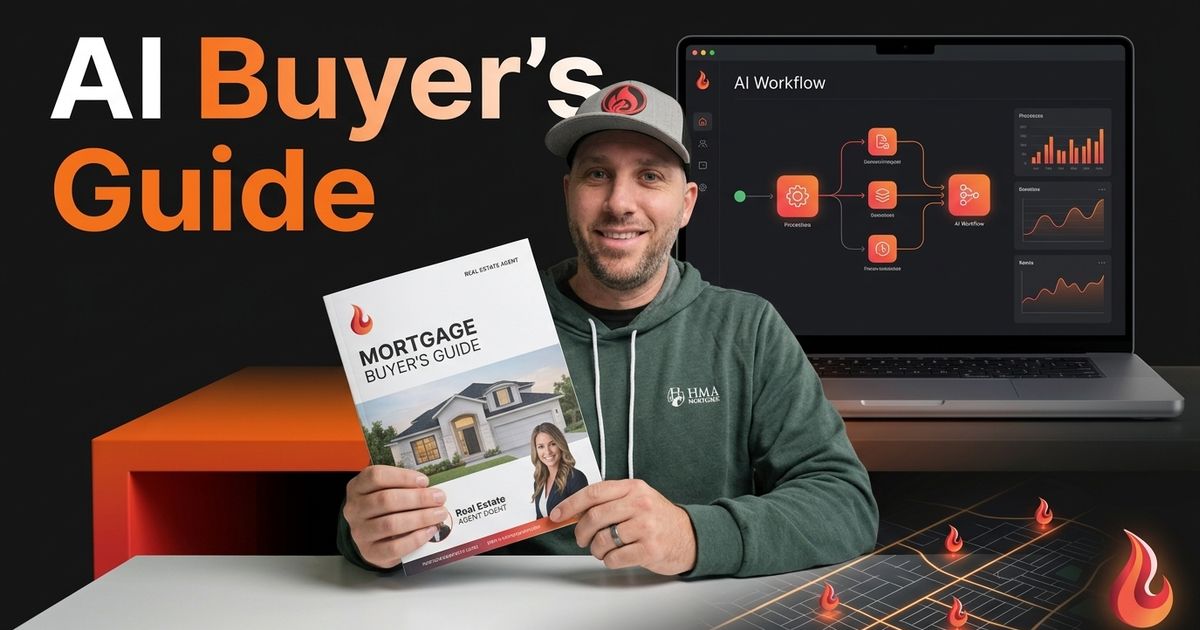
Co-branded buyer's guides used to be a vendor deliverable. You'd hire someone, wait a week, get back a generic template with two logos slapped on it, and your realtor partner would file it under "things I never read." That whole workflow is dead. With Claude and 20 minutes, any loan officer can build a fully custom, hyperlocal buyer's guide for any realtor partner, in their actual brand colors, with neighborhood data they actually care about, ready to send before they get back from the showing.
What is a hyperlocal buyer's guide?
A hyperlocal buyer's guide is a buyer-facing PDF or webpage that walks a first-time or move-up buyer through the home-buying process for a specific zip code or city, with the lender and the real estate agent co-branded as the providers. The "hyperlocal" part is what makes it work. Generic buyer's guides talk about national mortgage rates and "how to choose a real estate agent." Hyperlocal guides talk about the school district at the specific zip code, the days-on-market trend in that neighborhood, the property tax structure for that state, the down payment assistance program available in that city. They give the realtor a piece of marketing that actually means something to their buyer, and they put the LO's name on it as the financing partner.
The difference matters because realtors don't share generic content. They share content that makes them look prepared. A guide that says "Welcome to home buying" gets filed. A guide that says "Median sale price in [their zip code] last 90 days was $XYZ, here's what that means for your loan options" gets sent to every buyer they sign up.
Why do co-branded buyer's guides work for agent partnerships?
Most agent partnership conversations sound like this: "Hey, I'd love to be your preferred lender. Here's my flyer." Agents have heard that pitch every week for years. The co-branded buyer's guide flips it. Instead of pitching the agent, you're handing them a deliverable they can give to their next buyer in the first conversation. They look like a lender who actually invests in the partnership instead of asking for referrals every quarter.
You stop being a salesperson and become a resource. Jason Kindler, a DAI member and co-founder of First Coast Mortgage Funding, built an AI tool portal for agents around this same value-first principle and signed up 243 agents in his first 6 weeks. The buyer's guide is one of the simplest entry points to that same pattern. You're showing up with something useful instead of asking for anything.
What do you need before you start?
Three things. A Claude account with file upload (any paid tier works). The realtor partner's logo (any common image format). And the target zip code or city you want to build for. That's it. You don't need design software, template libraries, or vendor turnaround times. If you have those three inputs, you have everything you need to build the guide in one Claude session.
How do you build the guide in Claude in under 20 minutes?
The full workflow has four steps. Each step is one prompt. The whole thing runs faster than scheduling a coffee meeting with the realtor you're building it for.
Step 1: Upload the realtor's logo and extract their brand colors
The first move is the one most LOs would skip if they were thinking about templates. Instead of picking colors yourself or asking the realtor for a brand guide, upload their logo to Claude and have it pull the hex codes directly from the image.
Prompt:
"Look at this logo. Extract the primary and secondary hex colors, and identify any accent colors used in the design. Return them as a brand palette I can use for marketing materials."
Claude reads the logo, returns the actual hex values from the realtor's brand. The guide will match what they're already using on their website and signage. It looks intentional because it is intentional, and it took you 15 seconds.
Step 2: Research the target zip code
Now Claude needs to know what makes the area different.
Prompt:
"Research zip code [ZIP] in [CITY], [STATE]. I want neighborhood demographics, school district info, average home prices and days-on-market over the last 12 months, property tax rates, local down payment assistance programs, and any notable HOA or community-specific details a buyer should know."
This is where hyperlocal becomes real. The output is the difference between "a buyer's guide" and "a buyer's guide for the neighborhood I'm actually shopping in." That difference is what makes the realtor want to hand it out instead of file it.
Step 3: Generate the full guide in the realtor's branding
The third prompt brings everything together. You're feeding Claude the colors from Step 1, the neighborhood research from Step 2, and your output spec.
Prompt:
"Build a co-branded first-time home buyer's guide for [REALTOR NAME] and [LOAN OFFICER NAME]. Use the brand colors I extracted from the logo. Include all the neighborhood research from the previous response. Structure: cover page with both names and brand colors, intro to the area, how-to-buy walkthrough, financing options for first-time buyers in this state, down payment assistance section, closing-cost expectations, neighborhood-specific tips. Conversational tone. Make it useful, not promotional."
Claude writes the full guide in one pass. You'll typically read through it once and tweak two or three sections to add your own opinions or correct anything that's slightly off for the area.
Step 4: Output as a deliverable PDF
The last prompt makes it shippable.
Prompt:
"Output this guide as a printable HTML file with the brand colors applied to headers, callouts, and section dividers. Make the formatting clean enough that I can save it as a PDF and send it directly to the agent."
Claude generates the HTML. Open it in your browser. Print to PDF. Send.
That's the workflow. End to end, under 20 minutes. If you have ten realtor partners, that's a single afternoon and ten custom co-branded guides ready to go.
What are the RESPA compliance considerations for co-branded buyer's guides?
This is the part most "AI marketing for LOs" content skips, which is why the content sometimes gets dangerous to follow. Under RESPA Section 8, you cannot give a real estate agent a "thing of value" in exchange for the referral of mortgage business. The Consumer Financial Protection Bureau's RESPA Section 8 FAQ guidance is the authoritative source here.
A co-branded buyer's guide is generally compliant when it is marketing material made available to the public and not tied to specific referrals. Two practical rules to follow:
If your specific structure isn't clear under these rules, check with your compliance team or your company's RESPA counsel before deploying widely. The good news is the production cost is now nearly zero, which removes the "valuable consideration" concern that vendor-built guides used to raise.
How do you make this scale across multiple agent partners?
Build the workflow once as a Claude skill. The skill is just the four-step sequence above with the variables left as placeholders (logo file, zip code, realtor name, LO name). Save it as a reusable Project skill.
Next time you want a guide for a new agent, you load the skill, fill in the four variables, and the whole 20-minute process turns into a 5-minute process. This is how loan officers who build out their AI second brain compound their work over time. The first guide takes 20 minutes. The tenth takes 5. The hundredth takes 5 minutes too. Compare that to the old workflow where the hundredth guide cost the same $400 and one-week vendor wait as the first one.
The National Association of Realtors reports that 88% of buyers used a real estate agent to purchase their home in 2024, and agent recommendations remain the dominant source of lender referrals across the residential mortgage market. The LOs who scale custom co-branded materials become the recommended lender for more agents at once than anyone still ordering vendor work one guide at a time.
Frequently asked questions
Can I do this with ChatGPT instead of Claude? Use Claude. The file upload and color extraction step works meaningfully better than ChatGPT in our testing across 200+ DAI members. ChatGPT can also read images and write the guide if that's the tool you already have, but the output quality is noticeably lower for this specific workflow.
Does this work for refinance or HELOC buyer guides instead of purchase? Yes. Swap the prompt language from first-time-buyer framing to refi-borrower or HELOC-shopper framing. The Step 2 research changes (you'd ask about home value trends, equity growth in that zip, rate history instead of school districts and DPA programs). Everything else in the workflow is the same.
How long do these guides stay accurate? Neighborhood research has a shelf life. Market data goes stale in 6 to 12 months. Rebuild the guide once a year per zip code, or whenever a major rate or program change happens. Rebuilding takes 5 minutes once you've done the first one and saved the skill.
Should the agent or the LO own the file? Either works, but in practice the LO should own the master file and share a flat PDF with the agent. That way you control updates and can refresh the guide on your own timeline. Most agents prefer not to maintain it themselves.
Is there a way to make this look more "designed" without paying for Canva or hiring a designer? Claude can output increasingly polished HTML with prompts like "use Tailwind CSS classes" or "match this magazine layout style." For LOs who want true magazine-quality output, the workflow also exports cleanly to a tool like Ideogram for cover-page imagery. Most LOs find the basic HTML-to-PDF route produces guides that feel premium enough on their own.
What if the agent wants edits? Edit them in Claude in the same conversation. "Change the financing section to emphasize first-time-buyer programs more" or "Add a section on inspection contingencies." Claude updates the guide. Re-export. Send the updated version. Total turnaround on edits: 2 minutes.
Can I use this for builder partnerships, attorneys, or financial planners? Yes, and this is the bigger move most LOs miss. The same workflow rebuilds for any partner type. Realtors get a buyer's guide. Builders get a "new construction financing" walkthrough. Estate attorneys get a "probate sale lending" overview. Financial planners get a "tax implications of mortgage products" piece. One workflow, many partner types.
Where can I see other examples of loan officers using AI for partner relationships? DAI runs weekly coaching calls covering this exact pattern. The community shares working prompts, partner-pitch frameworks, and what's actually getting agents to respond. Start with how to get real estate agent referrals without begging for the broader pattern this fits into.
Ready to start using AI workflows like this every week?
Building one of these the first time is the test. Once you see what 20 minutes of AI work produces compared to what a vendor would charge $400 and a week for, you understand why DAI exists. There are 200+ loan officers inside DAI running these workflows every week. We share what works in the community, and the AI second brain builds we set up turn future production work into 5-minute jobs. See what $97/month looks like inside Direct Authority AI.
